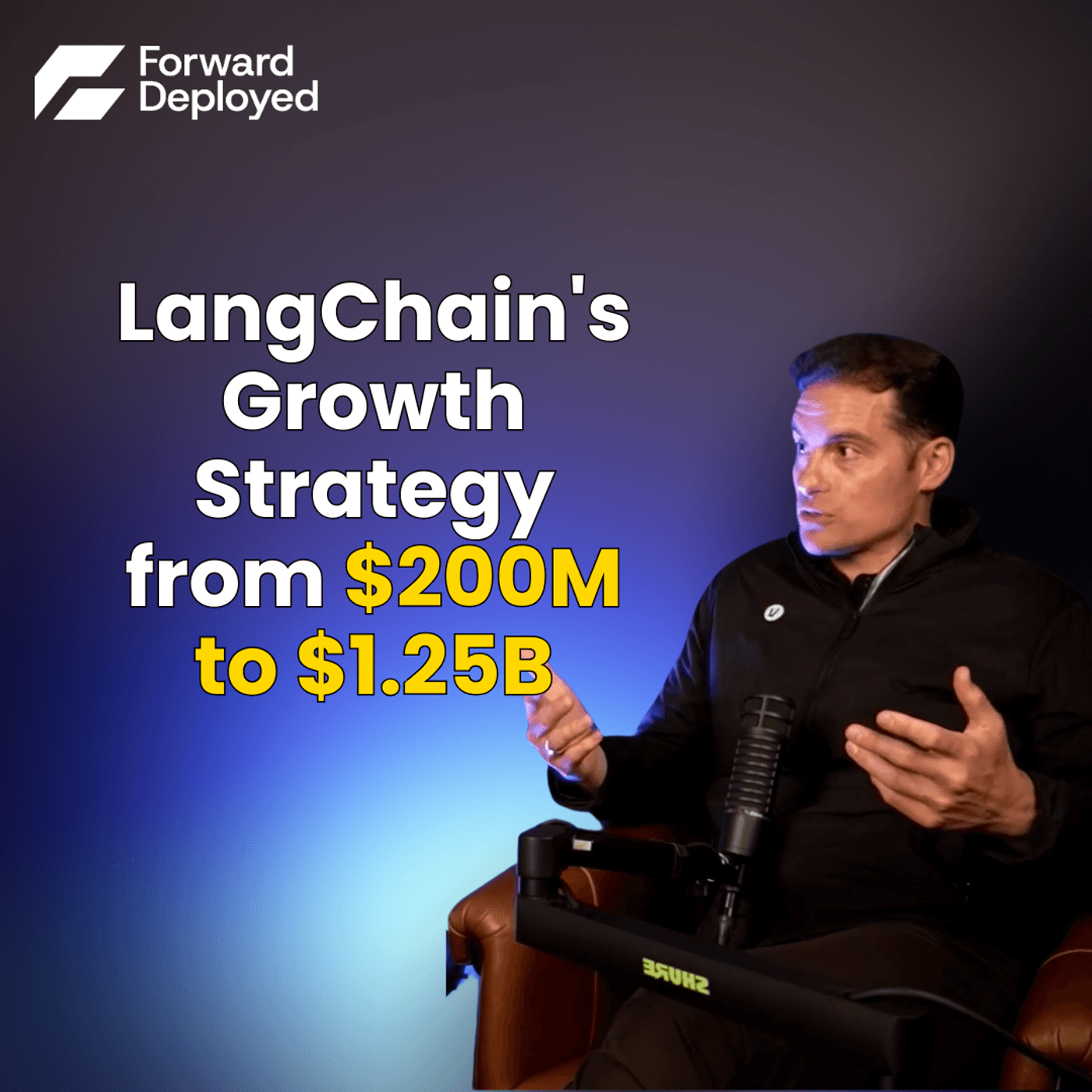
What this episode covers
A practical conversation on how infrastructure companies cross from open source adoption into enterprise value, and what that pattern teaches AI engineering teams shipping agents in production.
Why this matters in practice
Infrastructure adoption becomes enterprise value when teams can connect developer utility to trusted, measurable production workflows.
Chapters
- 00:00Intro
- 01:38From HashiCorp to LangChain
- 03:20Cloud wave vs AI agent wave
- 05:30Open source vs enterprise
- 06:23How LangChain's product stack evolved
- 07:37Why agents are finally in production
- 08:57What companies build with LangGraph
- 10:12LangSmith and Engine explained
- 13:23The Agent Development Lifecycle
- 16:36Build vs buy on voice agents
- 19:48Why owning your data and memory layer matters
- 22:12How open source users become paying customers
- 26:49Why LangChain hired forward deployed engineers
- 31:34What go-to-market looked like with 3 reps
- 35:31From 39 employees to hypergrowth
- 36:37Transitioning away from founder-led sales
- 37:07Why the CEO joined every early call
- 37:38The sandwich sale strategy explained
- 39:28Signals that an open source user is ready to buy
- 41:08Why outbound controls the narrative in enterprise
- 43:33Why in-person selling still wins
- 45:57Building an internal GTM agent to scale
- 47:37What the GTM agent actually does
- 50:16Why AI moves 50x faster than cloud did
- 53:46The vendor consolidation wave that's coming
- 56:14How to win the platform standardization deal
- 59:41Why staying model-agnostic beats the hyperscalers
- 01:01:23How Vince onboards new reps today
- 01:04:19The sales and engineering feedback loop
- 01:09:49Signals an account is ready to expand
- 01:12:57How to prove early value before full commitment
- 01:14:40How enterprises actually measure agent ROI
- 01:16:27Why automation is expanding beyond support
- 01:17:59Which industries are adopting agents fastest
- 01:19:07Healthcare agent use cases live today
- 01:21:17AI agents in finance and payments
- 01:22:40The Visa partnership
- 01:25:17What it takes to scale a sales team right now
- 01:27:44How the GTM agent is changing the SDR role
- 01:32:06Why the human element in sales still matters
- 01:34:28Platform deals vs point solutions
- 01:36:43Vince's predictions on memory and consolidation
- 01:39:23How Engine helps teams iterate on agents faster
- 01:43:19Forward deployed engineers vs Engine
- 01:46:20Where to find Vince and LangChain's open roles
Key takeaways
- Developer adoption versus enterprise buying
- What AI teams need to prove in production
- How agent infrastructure companies build trust
- Lessons for forward deployed AI teams
Enterprise AI adoption depends on trust, measurable workflows, and teams that can translate prototypes into durable business systems.
Related topics
More episodes
- Evals - Beyond the Vibe Check | LangChain, Langfuse, Mercor, CoreWeave & GalileoLangChain, Langfuse, Mercor, CoreWeave and Galileo
- The State of Computer Use Agents | Anthropic, Browser Use & KERNELAnthropic, Browser Use and KERNEL
- Spencer Whitman - Gray Swan AI's $200M Plan to Secure AI SystemsSpencer Whitman — Gray Swan AI