What this episode covers
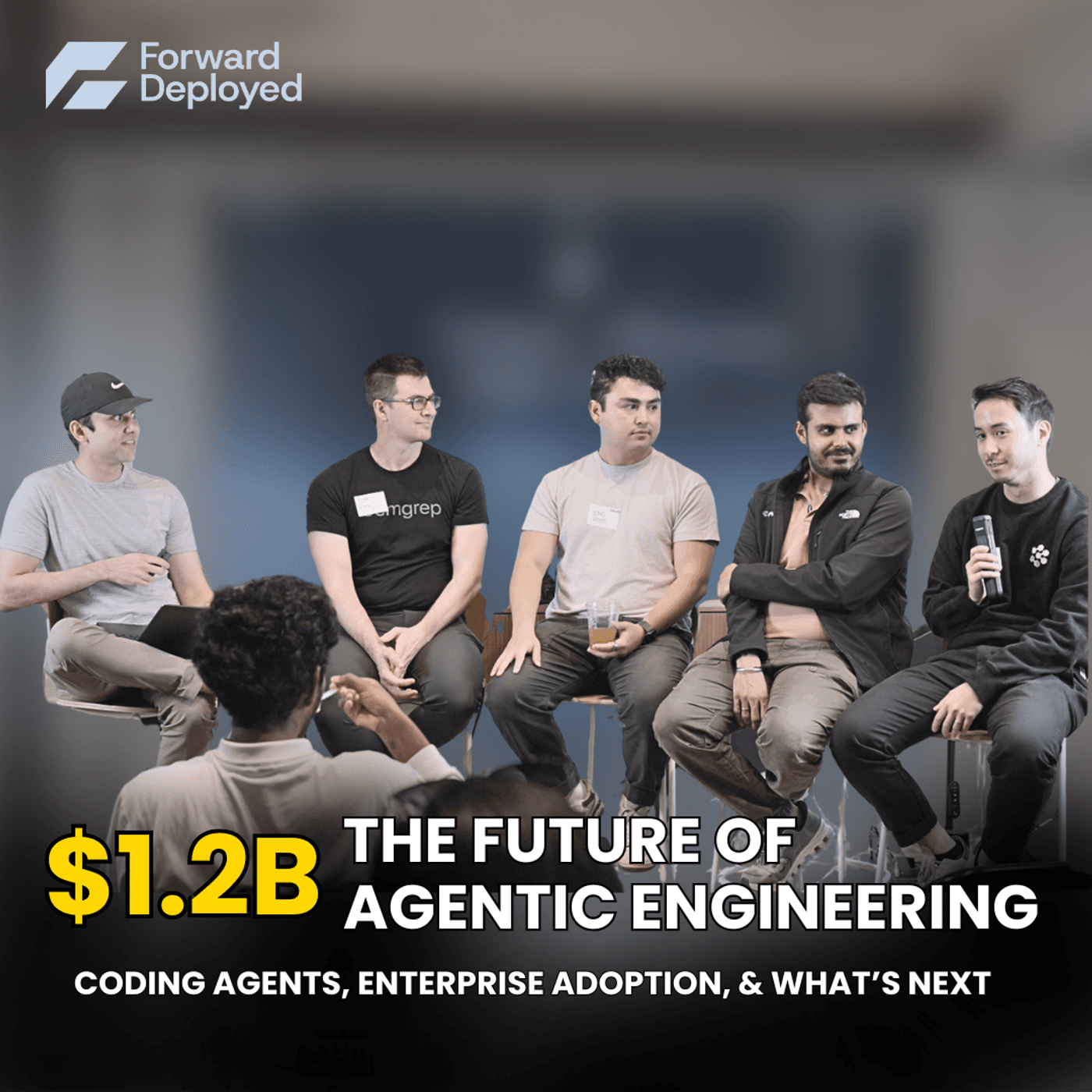
A multi-company view of agentic engineering, from coding assistants to autonomous workflows and the practices teams need before trusting agents in real repositories.
Why this matters in practice
Agentic engineering changes the software-delivery control loop, making evaluation, review, and bounded autonomy as important as code generation.
Chapters
- 00:00Welcome and setup
- 00:41Panel introductions
- 02:00Windsurf acquisition
- 03:52Do agents boost productivity?
- 04:16Agent-ready codebases
- 05:55Real-world enterprise wins
- 07:28Agents building integrations
- 09:41Security risks (vibe coding)
- 11:04LLM security tools landscape
- 12:21Defense-in-depth
- 15:16MCP security pitfalls
- 18:41MCP vs CLI
- 23:08RL for secure code
- 27:05Auto research missions
- 27:57Training your own models
- 31:33Distillation and IP decay
- 34:50Hybrid systems
- 37:14Side projects vs enterprise
- 40:16Forward deployed engineering
- 40:58Agent orchestration
- 43:08Cost controls
- 43:49Auto model routing
- 45:52Guardrails
- 47:02Legacy code risks
- 48:16Model poisoning
- 49:35What is a harness?
- 51:47Why build your own
- 52:58Continuous learning loops
- 56:30Security workflows
- 57:37Validation and meta engineering
- 1:00:32Running evals in practice
- 1:03:36Teams reshaped by agents
- 1:12:17Should you study CS?
- 1:14:11Enterprise adoption
- 1:18:23Local to cloud journey
- 1:20:51Agent economy and prompting
- 1:22:22Spec vs plan
- 1:25:12Closing and thanks
Key takeaways
- Where agentic engineering is working
- How teams evaluate coding agents
- Risks in autonomous software workflows
- What production agentic engineering requires
Agentic engineering is less about replacing engineers and more about changing the control loop around software delivery.
Related topics
More episodes
- Evals - Beyond the Vibe Check | LangChain, Langfuse, Mercor, CoreWeave & GalileoLangChain, Langfuse, Mercor, CoreWeave and Galileo
- The State of Computer Use Agents | Anthropic, Browser Use & KERNELAnthropic, Browser Use and KERNEL
- Spencer Whitman - Gray Swan AI's $200M Plan to Secure AI SystemsSpencer Whitman — Gray Swan AI